Sunday, 4 May 2014

TEACHING SCALES - Paul Harris & Richard Crozier

Scales and Technique
Scales are a fundamental part of technique - that area of musicianship embracing the control of all physical movement involved in playing an instrument or singing. Technique also controls tone, tone colour, intonation, dynamic level and rhythm. In performance, at any level, musicality will always be eclipsed if there is even a struggle with the technical content. However musically well-intentioned the performer is, without technical control that subtle dynamic shading or rhythmic manipulation will simply not be possible.

Teaching Strategies
The student needs to be convinced that scales are beneficial.
Methodical teaching is important - the 'just get on and learn them' approach works for very few pupils. It is essential that we never label scales as the least attractive part of an exam syllabus. Once said, it will be very difficult to change that perception - scales will forever be difficult both to teach and learn.

BY EAR OR NOT BY EAR
In exams scales have to be played from memory. This often encourages learning scales 'by ear' as the principal (and sometimes only) method. Ideally, all pupils should learn and play scales both from the music and by ear. Recognizing notated patterns is very helpful when learning pieces, and essential in building up a fluent sight-reading technique.Scales should never be learnt by simply feeling your way through; this will almost always result in mistakes and unrhythmic playing. Those players who get scales right the second or third time do not know them! Ultimately, a memorized scales is the result of many careful and thoughtful repetitions. 

SCALES LEARNING WITHOUT SCALES!
Here is a strategy for approaching the learning of a new scale. It is a series of steps that will gradually build up confidence and lead to fluent and reliable scale playing. 

First of all pupils should write down the notes names of the scale. (This is more important than you might think - to get the maximum benefit from scale practice, the mind must make a connection between the note name, the notational symbol and the physical action required to produce the note. You may find it a less than pleasant surprise to discover pupils do not actually know which notes they are playing.)

Once the note names are known they should be said out loud both ascending and descending.

Try some simple improvisation. Encourage pupils to improvise short tunes or pieces in the key of the scale being learnt. Keep reminding them to think in the key. These improvisations should include scale and arpeggio patterns as often as possible. 

(Many pupils don't think in keys. They tend simply to think in C major, adding the appropriate sharps of flats (if you're lucky!) It is important to encourage pupils to think in the key by continually reminding them to do just that. Each time they play a piece in a particular key, talk about that key, ask them to play the scale and arpeggio and remind them to have the key in mind during the course of performing the piece. This needs to be reinforced regularly until pupils begin to think  in keys as a matter of course.)

Another useful 'game' to play that further develops key-sense involves choosing a famous tune and playing it by ear, in the key being learnt. It does not matter if it takes a few attempts to get it right; this is good aural training because the pupil is really listening and making appropriate corrections if necessary.

MAKING FRIENDS WITH SCALES
Encourage pupils to familiarize themselves with their scales, as they would get to know characteristics of friends or relations. Ask them to make a list of three or four features of each scale. Here are two examples taken from actual lists made by young players:

Piano: F major hands together (Grade 2)
  • Right-hand 4th finger on the B flat.
  • Right-hand ends on 4.
  • Thumbs together on F in the middle.
Clarinet: E major (Grade 5)
  • It has four sharps - must remember the D sharp.
  • Begins on right-hand E.
  • The first three notes are all bell-note keys.
  • Bell-note fingerings are the same in each register.
  • It's my favourite scale (!)

Before asking a pupil to play a particular scale, always invite them to talk about it first; each scale will eventually acquire an identity of its own - pupils will really begin to know their scales.

Practice Strategies
  • Practise using different rhythmic, dynamic and articulation patterns to develop technical fluency and rhythmic evenness. Scales need hardly ever be practised the same way more than once!
  • Varying the tempo: slow practice for improving tone and intonation; fast practice for developing finger movement and fluency.
  • Varying the accentuation (by playing in groups of 2, 3, 4, 6 or 8) will also develop evenness and control.
  • Begin scales on any note, such as B major beginning and ending on E. This is a very positive way to help develop key-sense and will sort out those who really know their scales from those who 'feel' their way through them.
  • Play them legato ascending and staccato descending, then the other way round.
  • Pianists can play one hand legato, the other staccato,. Each hand can play a different dynamic level or shape.
With some imaginative and relevant teaching strategies, students may even begin to enjoy their scale practice! :-)))))

https://www.youtube.com/watch?v=khvaIwonxUk

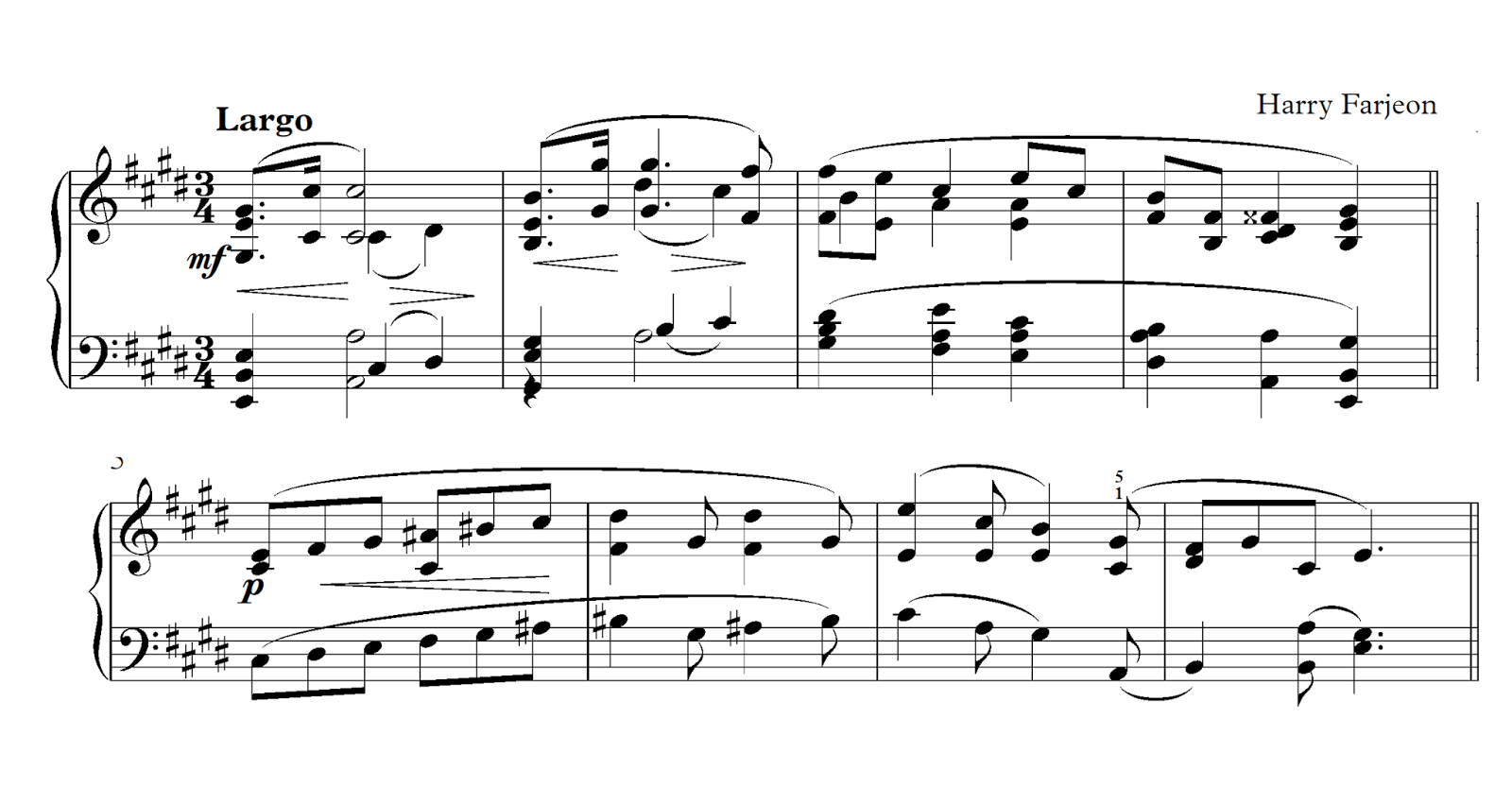
A KEY TO THE KEYS: PART III - F# MAJOR AND D# MINOR, Harry Farjeon

These are, I am ready to admit, terrible keys. F# is not bad to play. But to read it is undeniably a bit of a corker. Every note sharp except B (even poor inoffensive E has to be sharp now).
Now it is true that the key of F# is seldom used, but it is used rather more frequently than you think. One does not often see that horrific signature of six sharps. But a piece beginning in B major or even E major, or, again, in C# minor or F# minor, might very easily modulate to F# major; and then you would have the key though not the signature.

A Scale with Cadences
Example 1. Our scale this time has a new feature – it is not all in even-length notes. This should suggest to you a whole new dictionary of possibilities; for remember, remember and continue to remember, that in all the work you do for me, or because of me, I want you to be perpetually alive – I want you to think and to make up things so that everything you follow the direction others have pointed out, you have some share in the journey yourself, apart from the mere plodding.
The scale is rather easy to play like this, with a wait on each Tonic. The accents come out the same in every octave and the fingers get used to a certain balance that is never shifted.
The Cadence Chords at the end also are slightly different.


Black Key Exercise
Example 2. Exercise on Black Keys, one note in each hand alternately. This sort of piece is very comforting, for it can be played with the middle fingers.


Five More Examples
Example 3.  This is planned to show the position of the white keys in regard to the blacks, as already explained. Whites leading up and down a semitone to Blacks.

Example 4. An old friend in a new dress. F# is certainly not the key to suit this tune. But nothing is better practice in an unfamiliar key than to read (or play by ear) melodies and chords already well known by sound.


Examples 5 and 5a are examples of when F# major would and would not be used. Example 5 would certainly be written in that key, modulating as it does to A, so far on the sharp side. But if after the first four bars the music went on like 5a, it would be better to write the whole thing in Gb, going to Bb minor instead of A# minor.


Example 6. Bright running passages, very suitable to the key.


If tackled religiously, a fortnight dedicated to each part, these few examples should help you overcome the Key Signatures nightmare. Enjoy!! :-D

Tuesday, 22 April 2014

A KEY TO THE KEYS: Part II – B Major and G# Minor, Harry Farjeon

There are three major scales that call for all the pianoforte black keys and each of these scales has two names, B and C flat, F sharp and G flat, C sharp and D flat. They are not really identical, though they have to be expressed in the same way on the piano. Looked at from the piano point of view, there are just the three scales, and in these some of you will have found this special difficulty; to remember  which are the white keys – not the black ones, for these are all used.

Remembering the Black Keys
Now, how are we to remember which are the white keys in the scales of B, F# and Db? Each of these scales has 5 blacks and 2 whites, and it is easy to get confused.
B Major. The black notes are in groups of 2 and 3. As soon as each group is over play the semitone above; the next white key. After D#, E; after A#, B.
Db Major. For this, do the opposite. Before each black group play the semitone below. Before Gb, F; before Db, C.
F# Major. For this scale, concentrate upon the group of 3 black keys. When approaching and leaving each black group play the semitone. Before F#, E#; after A#, B.

Trying Prescriptions
We are now almost ready, but not quite, to tackle our exercises. I want to first point out to you a curious fact, or rather, I want to lead you to notice it for yourselves. Play a major and a minor Common Chord on every one of the twelve piano keys – the twelve making an octave. (It is from these chords, of course, that we get our ordinary arpeggios). Play them simply in three-note form: C. E. G; then C, Eb, G; C#, E#, G#, and so on, each major followed by its Tonic Minor. That will make twenty-four chords altogether’ twelve major and twelve minor.
Now notice where the black keys come, and where the white. White, white, white; white, black, white; black, white, black – here are the prescriptions for the first three.
C Major: White, white, white; yes, we have it again, often: G major, A minor – lots of them. C Minor: White, black, white; like F minor and others. C# Major: Black, white, black; at once we get it again in C# minor. In fact we….. but try them all yourself! J
…… And we find that the only ones that are quite by themselves, each standing alone and not being repeated, are all the B’s: B major, B minor, Bb major and Bb minor.

The Music Examples
Example 1. I begin once more with a scale, and I have put it in that rare and delightful time 9/8. This scale is rather less attractive, I regret to say, but at least it is not common. Remember that it is well to play each new kind of scale in all the old keys.
The chords at the end are our good old friends Subdominant, Tonic and Dominant, but with different notes in the Treble.


Example 2. is in the style of one of the exercises I gave in Part I, the right hand having all the black keys and then all the whites. Only two white ones left.


Example 3. Arpeggios, tossed about from hand to hand, as it were. This example brings in the five chief chords in the key, and is therefore a very useful one to transpose. Next in importance to the Tonic, Dominant and Subdominant come the Submediant and Supertonic, and you will find these all here. Really, I strongly urge you to transpose this, both as it stands and as plain chords without arpeggio.


Example 4. This, and the next two are more in the nature of pieces. 3/2 is another rather unusual time.


Example 5. I put this one in to show you what terrific accidentals there can be among the chromatic notes of B major. :-D


Example 6. Just one in G# minor, for completeness’ sake. I’m really not going to bother much about the worst ruffians among the minor keys - they are so seldom admitted to any sort of society. A# minor and D# minor I intend to simply ignore, unless my heart softens to them (or hardens to you). But this one bit in G# minor we may have, just to get used to Fx (F double sharp), which is the least villainous of all the double sharps. :-)


Monday, 21 April 2014

Cages or Signals? :-D

A glance at the dictionary will show you many meanings of the word “bar.” How we think of things matters very much, both in life and in music, and few things are more misunderstood than the simple upright bar-line.
Those people whose playing is dull and lifeless, without the swing and go which is the essence of music, think of bar-lines as the bars of a cage, made to prevent the notes of one bar getting out and fighting those in the next cage. But if you who want to play or sing well, like an intelligent being, think of yourself as an engine driver, and your bar-line as a signal saying, “All clear: strong accent near.” Then full steam ahead, drive your train of musical thought gaily on to the accents, and good rhythm will be yours.

Wednesday, 16 April 2014

A KEY TO THE KEYS – Harry Farjeon: PART I - E Major & C# Mino

E MAJOR: 4 SHARPS
The new sharp is D sharp. Take a good look at it. Is it any worse than the others? Is it any blacker, or any bigger? “No,” says Somebody; “not that, but I call it E flat.”
Ah, but you mustn’t, Miss Somebody, when you meet it in the sharp keys. You don’t want a scale like this:
Scales and Arpeggios
Example  1. About this scale you will notice that it does not begin on the first beat of the bar. You should learn to play your scales in all manner of ways, as you will have to play them in your pieces – not just in the same old way, probably arrived at by chance and not thought about at all. Different times, different accents, different louds and softs, different cresces and dims. and different kinds of tone quality.
Remember, you are not supposed to play each scale only in the key in which I present it. Every scale should be dressed out in as many keys as you can manage – every scale and every passage, too; transposition is one of the chief qualities of good musicianship, and the more keys a scale, or anything else, can dress up in, the more use it will be in the world.
The chords at the end of Example 1 are the principle chords in the key. It used to be a good custom of the good old times to finish up every scale in this good old way, and a jolly good old thing, too! It helps one get used to the bones of a key. A useful variation is to play F sharp in the Treble of the first chord instead of E.  If you can bring off these two varieties successfully in all the keys you know, and later in all the keys you are going to know, you can face the world with a calm heart and a contented mind.

Example  2. This is just arpeggios of the same three chords. Again you can substitute F sharp for E in the chord of A. This turns it from the Root Position of the Subdominant into the First Inversion of the Supertonic, and it is well to remember that these two chords lead up naturally to Cadence points – being, indeed, good before all Cadences except the Plagal.


Example  3. This is set to make you concentrate upon the black keys. You will see that these are all given together alternately with all the white ones. This exercise is not to be transposed, as the special notes pointed out have no particular significance in other keys. By the way, all the exercises should be played four times over, without stopping. A single run through will not impress them on your memory.


Example  4. This consists of scale passages built upon the three chief chords of the key. By now you should be growing familiar with these chords. :-)

C SHARP MINOR
Example  5. Now we come to C sharp minor. Begin by transposing Ex. 1 into this key, playing the scale in two ways (Harmonic and Melodic Minor) but the chords in one way only (Harmonic). Then tackle Ex. 4, and “realize” by hard thinking, the same three Primary Triads on which it is formed.

Example  6. This is a little nearer to being a “piece.” It begins in E major, modulates to C sharp minor, and comes back again.

Example  7. Bigger chords and more varied harmony, for larger hands and wider experience. The only chromatic note I have used at all comes in this example.


Having played all these four times over, and having repeated this task three times during the day for shall we say a fortnight? – you will begin to dream of E Major, or better still, you will consider it so ordinary that it will not be worth dreaming about :-D

A PRIZE - Harry Farjeon, October 1933

There are three ways of winning prizes by merit. I don't mean the various ways there are of winning by luck, such as sweepstakes and the shilling in the Christmas pudding.
Of course, even the  merit may have a good deal of luck mixed up with it; on the day of the examination you may draw a horse in the shape of a special amount of good health and vitality, while Molly Mope, who really plays better than you, may be prostrated by one of her sleepless nights. Or you may find one of those Christmas-shilling examiners who put everybody at their ease and give them lots of marks to spend; while Molly, at another centre, may have one of the plain-pudding stingy kind, with neither shilling nor plums, who likes to keep all the marks to himself.

Three Ways of Winning
Now what are the three ways of winning prizes by merit?
No. 1 By competition. Lots of people try to be the best, and one of them is best.
No. 2 By individual candidature. One person tries to reach a certain standard, and is passed or failed.
No. 3 By selection without examination - without entering for the prize, or perhaps even knowing that it exists.

The most famous prizes in all history in Class No. 1 are the wreaths given to the victors in Ancient Greece at the Olympic Games. In Class No. 2 I don't know that history can show anything to beat the Matric., and the Associated Board (ABRSM) exams; while in Class No. 3 the Nobel Prizes hold pride of place.

Prizes are Nice
Of course, it is always nice to win a prize. Even a present is nice, but with a prize there is the pleasure of being something as well as that of having something. 

Sport is Not Enough
In England we love competitions; more than in other countries are they loved here, because of our feeling for sport. This is all very well, so long as we realize that, in Art, as in life, sport is not enough. And in art sport must be supplemented by work. In both, too, sport and work must be supplemented by play - play of the fancy in art, just as in games, indoor and outdoor, there must be play of the brain and the body.
Above all, if you wish to succeed without swank, feel that you are working for something outside yourself. For your teacher, for your team, for your school - and, above all, for your art.


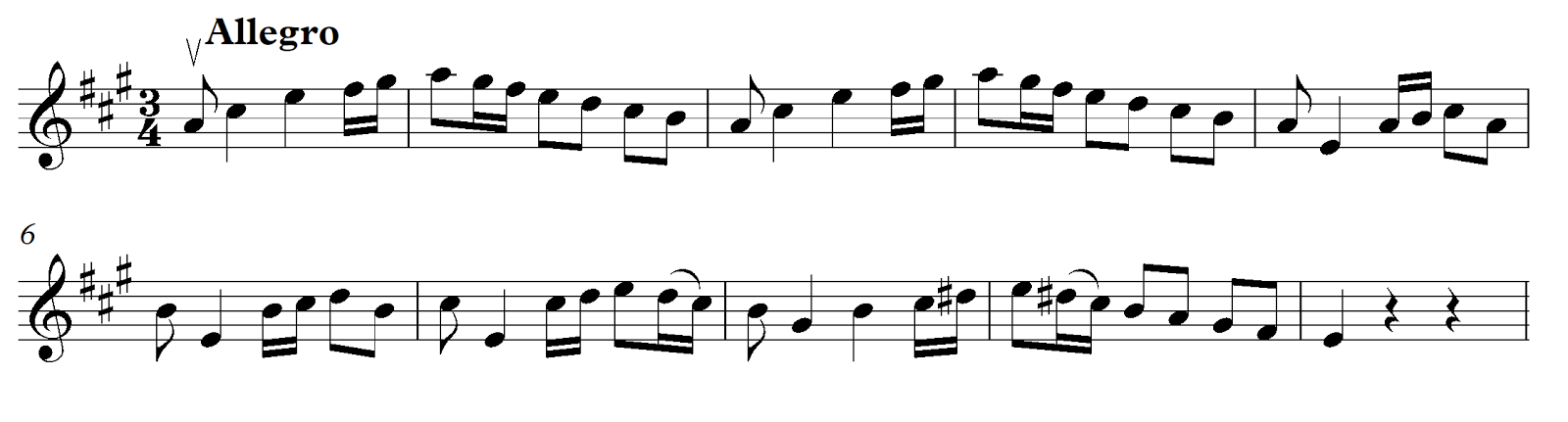
:-D VITAMINS FROM VIVALDI ~ SOME PRACTICAL EXERCISES FOR VIOLINISTS :-)

1.       Silent Crossing of Strings – Play this exercise as much as possible in the first position, and it will give you some good practice in crossing strings.


2.       Melody – This is a typical Vivaldi tune. Play it with a full silky tone, and see how imperceptible you can make the changes from down bow to up bow, and vice versa.


3.       Trills – Practice this in both first and third positions, making your trills as quick and neat as possible. It is the opening subject of one of Vivaldi’s concertos.


4.       Double-Stopping – Here is a specimen of Vivaldi’s double-stopping. Use only the lower half of the bow, with plenty of wrist movement, and try to touch your two strings exactly together.


5.       Passage Work – Vivaldi’s concertos are full of passages of this sort. See that your bow and the fingers of your left hand work well together, and watch your intonation.


6.       Syncopation – An early eighteenth century specimen. Use a short up bow for the beginning of each phrase, and play with clean, crisp accents.